
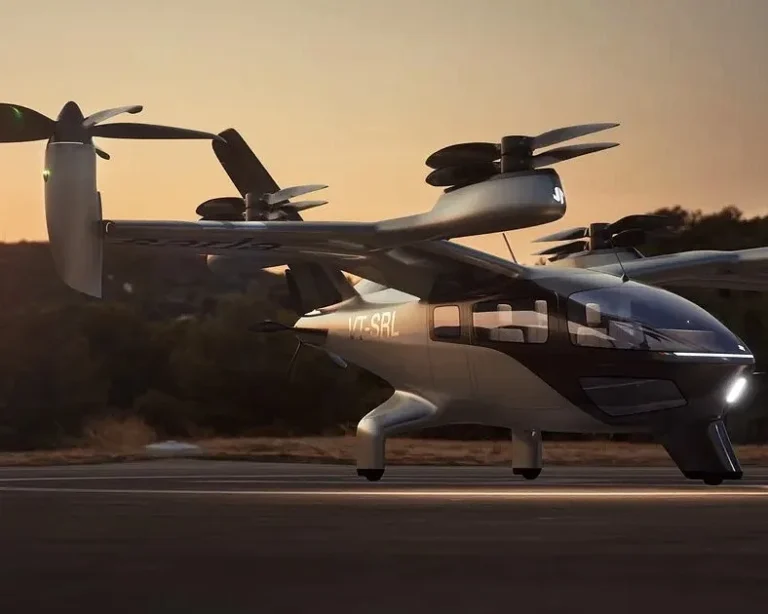
India to Have Air Taxis by 2028-29; Sarla Aviation Shows Half-Scale eVTOL Demonstrator

Sarla Aviation receives Design Organisational Approval (DOA) from India’s aviation regulator DGCA. Develops a half-scale eVTOL demonstrator, SYL-X1. The full-scale model, once completed, could be India’s largest air taxi by payload.
If all goes according to plan, India could soon see air taxi’s flying across its skies. Bengaluru-based Sarla Aviation, a three-year-old start-up recently received Design Organisation Approval (DOA) from India’s aviation regulator DGCA as it targets commercial air taxi operations around 2028–2029. The start-up has developed a half-scale eVTOL demonstrator named Sylla 1.0.
eVTOL stands for electric vertical takeoff and landing. It is a type of aircraft that uses electric power to hover, take off, and land straight up and down. These vehicles do not need runways, making them ideal for short-distance urban travel and air taxi services.
Apart from public transportation, eVTOL aircraft can also be used for transporting workers to offshore facilities (such as drilling rigs) and for landing on aircraft carriers. But range and safety are crucial for such applicaitons. eVTOL aircraft may prove to be more cost effective than fossil fuel powered aircraft such as helicopters.
On 8 August, 2026, as Sarla Aviation opened the doors of its new headquarters in Bengaluru, the Honourable Minister of Civil Aviation, Shri Ram Mohan Naidu, handed the company the DOA from the Directorate General of Civil Aviation (DGCA). Granted to a company barely three years old, it is the fastest-ever DOA in Indian aviation history, and the foundational first step on the certified path to flight.
The quick DOA issuance and pace of regulatory framework development show the urgency to start air taxi services, especially in India’s overcrowded cities.
The Minister described eVTOL as a priority for the Government of India and set out his expectation that air taxis become a mode of mass public transportation: “We have to ensure this is not only for a certain class of people, a certain segment, or just the urban metropolitan areas. We have to ensure these machines fly everywhere in the country.”
He also underlined the pace at which India’s regulatory framework is being built and that India published its eVTOL framework within 13 months, a process that took the West nearly a decade, supported by 100 per cent FDI in the sector and six dedicated working groups covering vertiports, eVTOL certification standards, crew licensing, air operator permits, unified traffic management and MRO. “At this speed, I believe that within two years we are going to see this ecosystem flourish in the country,” he said.
The minister also offered to personally intervene if any entity in the ecosystem faced hurdles, in terms of clearances.
Sarla Avaition Pioneers eVTOLs
Earlier this year, Sarla Aviation showcased its full-scale six-passenger prototype named Shunya at the Bharat Mobility Global Expo. It outlined plans to introduce electric vertical take-off and landing (eVTOL) aircraft in Bengaluru by 2028. Shunya is a six-passenger commercial air taxi powered by seven electric motors.
The company has now begun ground testing of its half-scale eVTOL demonstrator, SYLLA SYL-X1, which features a 7.5-metre wingspan. Sarla Aviation said SYL-X1 is currently the largest privately developed eVTOL demonstrator under development in India.
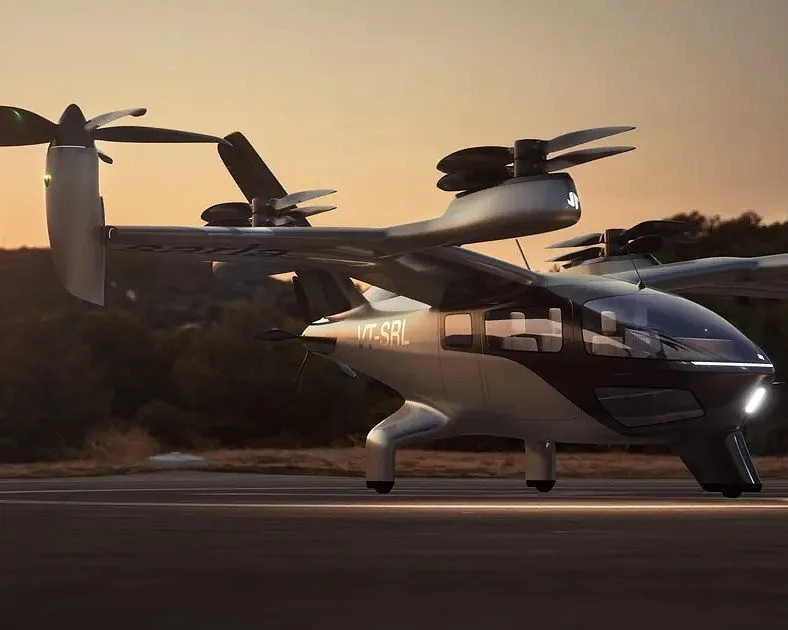
The Sylla 1.0 Demonstrator is a 700 kg-class half-scale uncrewed prototype that completed over 500 tests and 18 hours of flight/hover trials.
Commenting on India’s air taxi plan, Gautam Sharma, Managing Director, Viasat India said, “The government’s target of air taxis flying in India by 2028, backed by home-grown players, marks a genuine inflection point for Indian aviation. It signals regulatory intent and industrial ambition, but as the ecosystem moves from prototypes to passenger operations, equal focus is needed on the safety, connectivity and airspace management layers.
Going by the announcement, eVTOLs will operate at low altitudes over dense urban corridors, where GPS and terrestrial networks may fall short. Command-and-control links therefore need protected, aviation-safety-certified spectrum, not just best-effort broadband. This is where L-band matters, the same class of spectrum that supports safe connectivity in commercial aviation today. India’s Advanced Air Mobility ecosystem needs dedicated L-band access secured early, so safety is built in from day one rather than retrofitted later. This requires aircraft makers, connectivity providers, airlines and civil aviation and spectrum authorities to align well before 2028. It is crucial to get the spectrum and safety foundation right, which would allow India to not just meet its timeline, but also set a credible template for advanced air mobility globally.”
While Sarla Aviation may be a pioneer in air taxi services, with the launch of its eVTOL aircraft, other Indian manufacturers are also expected to step in, especially those with experience in the manfacture of drones and unmanned aerial vehicals.
Globally, air taxi services are not yet fully operationalised. But regulated test flights, demonstrations, and early commercial route trials are active in parts of China, the United Arab Emirates (Dubai), and the United States.
India could be among the first nations to launch air taxi services.
Analysis and additional comments by Digital Creed (in Italics).
