
How CISOs Will Benefit From Microsoft’s MAI-Cyber-1-Flash Tool and Project Perception

Microsoft announces 𝗠𝗔𝗜-𝗖𝘆𝗯𝗲𝗿-𝟭-𝗙𝗹𝗮𝘀𝗵 multi-agent vulnerability identification and remediation harness. The tech giant claims it delivers “world-class performance” at 50% of the cost of leading frontier models. It is bringing this capability to market through 𝗣𝗿𝗼𝗷𝗲𝗰𝘁 𝗣𝗲𝗿𝗰𝗲𝗽𝘁𝗶𝗼𝗻, a complete agentic security offering grounded in real-world signals and security workflows.
Recent advances in AI have been phenomenal, and this technology is transforming almost every industry today. Yet, bad actors have also harnessed this technology to increase the sophistication, scale and velocity of attacks on individuals and enterprises. Autonomous AI threats such as Anthropic Mythos and OpenAI’s GPT-5.6 Sol are new challenges for CISOs and even nations. While security teams have been using advanced frontier models for defence, the cost of using these tools is prohibitively high. But now, Microsoft is announcing security tools at half the cost, and industry benchmarks show Microsoft’s MAI–Cyber–1–Flash has outperformed frontier models including Anthropic’s Mythos 5, OpenAI’s GPT-5.5 Cyber, and Google’s Gemini 3.5 Flash Cyber, in AI-enabled defense.
MAI–Cyber–1–Flash, is Microsoft’s in-house cybersecurity model running inside of MDASH, its multi-agent harness that detects and remediates vulnerabilities across large-scale code bases.
In a post on X, Microsoft CEO Satya Nadella said, “MAI–Cyber–1–Flash is our first cybersecurity model, built ground up to find the most challenging vulnerabilities in complex code bases. When combined with MDASH, it delivers world-class performance at 50 percent of the cost of leading models.”
Microsoft is bringing this capability to market through Project Perception, a complete agentic security offering grounded in real-world signals and security workflows.
Teams of specialized agents work together to simulate attacks, detect and triage/investigate, and fix and remediate. This is the benefit of building the harness, context/signals, and action space separate from one model family.
“By combining specialized models and data with the right agents, tools, security context, and harness, we can advance the frontier of cost to outcome,” Nadella said.
In a blog post on the Microsoft AI site Mustafa Suleyman, CEO of Microsoft AI, writes: “As the cost of finding a flaw collapses, the old model of security, where you scan occasionally and patch eventually, is now obsolete. If we’re to unlock the true benefits of AI, we must first build outstanding cyber models that help all of us harden the software the world runs on.
That’s the motivation behind MAI-Cyber-1-Flash, which has been built to find challenging vulnerabilities in complex codebases. It’s been deeply integrated into MDASH, honed by the best cybersecurity experts in the industry and hardened across the largest security estate on the planet.”
High-Accuracy Vulnerability Detection
In complex codebases, false positives consume significant security team resources, while false negatives lead to breaches. Hence, the need for highly accurate vulnerability detection, and MDASH system with MAI-Cyber-1-Flash has proven itself.
On the independent CyberGym benchmark (developed by UC Berkeley’s Sunblaze Lab to evaluate AI agents):
- The MDASH system with MAI-Cyber-1-Flash achieved a 95.95% (96%) success rate.
- This score outperformed top general-purpose models, including Anthropic’s Mythos 5 (by ~12 percentage points), OpenAI’s GPT-5.5 Cyber, and Google’s Gemini 3.5 Flash Cyber.
CyberGym is a cybersecurity evaluation framework designed to rigorously assess the capabilities of AI agents on real-world vulnerability analysis tasks. CyberGym includes 1,507 benchmark instances with historical vulnerabilities from 188 large software projects.
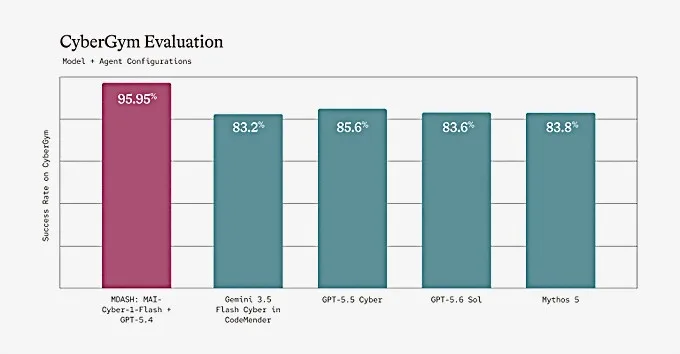
MAI-Cyber-1-Flash score outperformed top general-purpose models, including Anthropic’s Mythos 5 (by ~12 percentage points), OpenAI’s GPT-5.5 Cyber, and Google’s Gemini 3.5 Flash Cyber.
Analysis
Microsoft’s announcement of MAI-Cyber-1-Flash integrated into MDASH (and the accompanying Project Perception agentic framework) represents a strategic shift for CISOs and the broader cybersecurity community for the following reasons:
Shift in Cybersecurity Economics (50% Cost Savings)
Deploying frontier AI models (such as GPT-5.4 or Claude class models) for continuous, enterprise-wide code auditing has historically been cost-prohibitive. MAI-Cyber-1-Flash solves this through a tiered, multi-model approach:
- 90% Workload Offloading: The smaller, specialized MAI-Cyber-1-Flash model autonomously handles roughly 90% of routine security tasks, including initial vulnerability scanning, patch generation, and verification.
- Selective Escalation: Only the top 10% of exceptionally complex or novel tasks are escalated to larger, more expensive frontier models like GPT-5.4.
Impact for CISOs: This hybrid architecture slashes operational costs by approximately 50% compared to previous frontier-only configurations, making continuous AI-driven security auditing financially viable at enterprise scale.
Impact for SOC analysts: Fewer false positives and prioritization of top threats results in faster remediation, and less burn-out.
Countering AI-Driven Threat Velocity
Attackers are increasingly using AI to scan open-source repositories and enterprise codebases for zero-day vulnerabilities at machine speed. Traditional security approaches – such as periodic static analysis scans followed by manual patch cycles – are no longer fast enough to prevent exploitation.
- Autonomous Remediation: Through MDASH, security teams move from static alert logging to automated fix verification. The system not only detects flaws but generates proof-of-concept exploits to verify them and proposes code-level patches.
Continuous Multi-Agent Security Operations
Alongside the model, Microsoft introduced Project Perception, which operationalizes MDASH by organizing AI into specialized agent teams:
- Red Agents: Continuously simulate attacks and hunt for exploitable flaws before external actors find them.
- Blue Agents: Triage alerts, analyze contextual risk, and filter out false alarms.
- Green Agents: Propose and, upon administrator approval, automatically apply hardened code fixes. This structure allows SOC (Security Operations Center) teams to shift from reactive incident response to proactive, automated posture management.
Enterprise Guardrails and Human Control
For CISOs concerned about AI safety, unconstrained agent behavior, or code exposure, MDASH incorporates enterprise-grade security controls:
- Human-in-the-Loop: High-impact changes or patch deployments require explicit customer approval before execution.
- Isolated Environments: Scans and agent operations execute within sandboxed environments without internet access, backed by tenant isolation, role-based access control (RBAC), and full audit logging.
The writer is also a security professsional certified by ISC2 and EC-Council.
