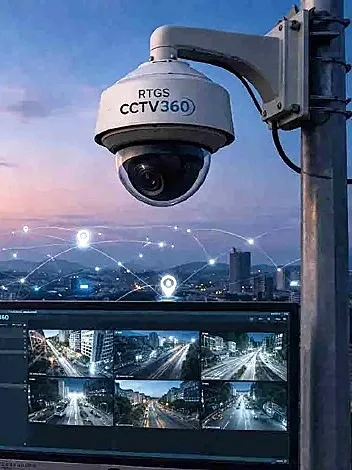
How Videonetics Developed Andhra Pradesh’s Statewide AI-Led CCTV360 Real-Time Governance System

Within weeks of going fully operational, Videonetics powered CCTV360 (RTGS), an AI-Led, Real-Time Governance System, began delivering outcomes that go well beyond enforcement statistics. Here are some actual outcomes delivered in the Indian state of Andhra Pradesh:
- A stolen two-wheeler reported in Bapatla district was recovered within 3 hours. The vehicle was tracked across districts via ANPR and recovered by police in Tenali.
- Two 11-year-olds reported missing were reunited with their families in under 4 hours. Missing from Yelamanchili they were identified using the Face Recognition System at Visakhapatnam Railway Station and reunited with their families in under 4 hours
- A Non-Bailable Warrant offender was flagged by the Face Recognition System at Tirumala Bus Stand, Tirupati, and taken into custody within 81 minutes
- A statewide facial recognition alert issued for a woman who was missing for over a month from Anantapur, helped trace her location at Puttaparthi the very same day.
Beyond these individual cases, Andhra Pradesh state officials reported a broader pattern of reduced crime rates, faster investigations, and measurably safer roads through consistent, automated traffic enforcement – all thanks to an advanced traffic management system operational across more than 680 crucial intersections.
E-governance outcomes are plentiful when you link a network of IP cameras (CCTV) with an AI-powered unified management platform. The real-life examples described upfront in this story were possible after Videonetics, a provider of video management software, succesfully deployed its AI-powered Unified Video Management Platform across all 28 districts of Andhra Pradesh. This large-scale implementation, called CCTV360 RTGS, establishes a connected, real-time intelligence network that enhances public safety, optimises traffic enforcement, and enables data-driven decision-making across the state.
 In an exclusive interaction with Digital Creed, Tuhin Bose, Senior Vice President & Chief Technology Officer, said he and his cofounder wanted to build an Indian product that addresses local challenges. The platform was co-developed with the client (officials of Andhra Pradesh) and evolved with continuous feedback.
“When we embarked on this initiative, we understood that a product that works in other markets will not be sustainable in India. So we educated our customers and understood our customer requirements. We also communicated the limits of the technology and what was not possible to do. It was a collaborative effort.”
At the core of this transformation is Videonetics, a unified platform which brings together video management system, AI-driven analytics, traffic management, e-ticketing, and face recognition within a single architecture. Approximately 15,000 IP cameras have been installed across critical locations, enabling continuous monitoring and seamless data flow into the command centers.
Videonetics’ Unified Video Management Platform, powered by an indigenously developed True AI and deep learning engine, offers a comprehensive, modular, yet integrated solution. This platform includes cutting-edge applications such as Video Management System (VMS), Video Analytics (VA), Traffic Management System (TMS), and Face Recognition System (FRS). Trained on extensive data sets, our solutions are robust, intelligent, and adaptable across various industries and sectors. Our products are cloud-ready, cloud-agnostic, ONVIF compliant, and OS & hardware agnostic, ensuring they are scalable and interoperable.
A key highlight of the rollout is the advanced traffic management system operational across more than 680 crucial intersections. This system automates detection of violations such as over-speeding and signal breaches, while also enabling identification of blacklisted vehicles which in turn significantly reduces manual intervention and improves enforcement consistency.
Additionally, the face recognition system deployed at nearly 1,000 locations assists authorised law enforcement agencies to identify persons of interest through integration with approved national databases which are in compliance with regulatory frameworks.
Built across roughly 15,000 cameras and integrated with the state’s criminal records, traffic enforcement, and command-and-control systems, the CCTV360 (RTGS) gives Andhra Pradesh’s police a single operational layer that connects every camera, database, and district in real time.
Bose believes this is the largest project of its kind in India. The extent of integration and curation of data from various systems, combined with close inter department communication makes this project successful.
“We extract intelligence from all those things and try to correlate that. Also, given the tool in terms of mobile apps for the police officials, whenever they want to search for a vehicle with this number plate, or a person with a certain facial profile, so you can simply use the system to search and immediately, it will search in railway stations, in airport indicates, wherever the cameras are there, and start giving them the feeds. Apart from providing feeds, it will also give the information and the notification.
The analysis of [camera] footage captured, enables them to make decisions in real-time. It’s not just a video file getting processed. You need real-time environments with 200 – 300 millisecond latency to generate information,” Bose said.
Officials cannot wait hours for this information after a crime has occured, as the criminals are moving interstate, with stolen goods or kidnapped victims. That’s why real-time analysis of the feed is crucial.
Implemented in partnership with MATRIX Security & Surveillance Pvt. Ltd., the deployment integrates a vast network of cameras, analytics engines, and enforcement systems into a centralised Command and Control Centre in Amaravati, creating a unified operational backbone for statewide monitoring and response. Built on a modular and scalable architecture, the platform is designed to evolve with the state’s future requirements. The Andhra Pradesh deployment stands as a strong benchmark for how AI-powered video intelligence can enable safer cities and more responsive governance at scale across India.
As told to Brian Pereira. With input from a statement dated July 1, 2026.