Global Outages: Don’t Ignore the Plumbing

Two major outages hit the world last weekend: the Microsoft 365 cloud service outage and the U.S. air travel disruptions. Both are being called the longest outages yet in their respective domains, and in both cases the cause has been traced to “faulty plumbing.” Allow me to explain what could have been done to avert these incidents.
I’ve already written about the Microsoft outage, and you can read that post here. On Saturday, Microsoft said it had restored M365 services, and I could access my Outlook email by late Saturday afternoon.
Businesses around the world were affected, as they depend heavily on Microsoft 365 services such as Teams, Outlook and Copilot for internal and external communications. Even integrated applications, such as Anthropic’s Claude, were affected. In fact, outages reporter site, Downdetector, registered complaints from 74 countries and territories within the first hour of the outage. Yes, that’s how dependent we are on Microsoft. That’s the scale of the impact.
Microsoft traced the outage to a “technical fault” that surfaced during an upgrade involving a network change. A cyberattack was ruled out.
Flight Disruptions in the U.S.
The website FlightAware reports that 6,400 U.S. flights were cancelled and more than 8,000 were delayed over the weekend. The figures vary across reports, but the scale of the impact is huge.
Again, this was not caused by a cyberattack.
The problem was traced to a telecommunications failure. More specifically, a network router and switches were flooded with data and began transmitting inconsistent information to all 22 regional air route traffic control centers (ARTCCs). The issue surfaced when L3Harris, a contractor, began upgrading ageing copper cables to fibre-optic systems.
ARTCC is a Federal Aviation Administration (FAA) facility that manages aircraft in the en-route phase of flight—typically at higher altitudes between departure and arrival airport areas.
Lessons Learned
What have we learned from these two outages? And will regulators (FAA, ICANN) be able to enforce measures that prevent similar disruptions in future?
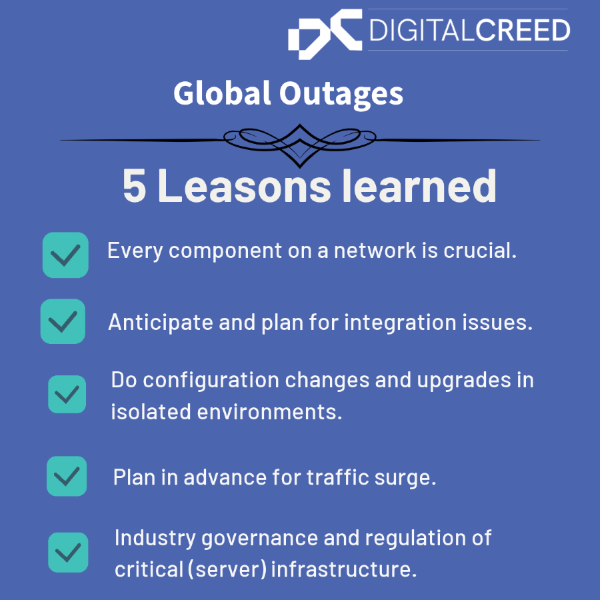
Lesson 1: Every component on a network is crucial. Components and systems must be upgraded/updated routinely.
Lesson 2: The air travel industry is known to run on legacy infrastructure, so upgrades and replacements must be carefully thought through. What problems could arise when you integrate decades-old systems with modern systems and processes? How do you plan for contingencies if things fail? Do you run parallel or backup systems? These are essential for mission-critical operations that involve human safety.
Lesson 3: As we know, this isn’t Microsoft’s first outage. So how should it be handling configuration changes? Shouldn’t these be simulated and tested in sandboxed (isolated) environments, with a rollback mechanism in case something goes wrong? Weren’t we all taught to roll out updates to production only after testing?
Lesson 4: Network traffic will keep growing, especially during the holiday season and major world events. What measures do we deploy to handle this extra traffic? I’m talking about load balancing across server clusters.
Lesson 5: Governance of critical servers. The internet would be crippled if half of its 13 root servers went down today. Yet those 13 root servers are maintained by 12 independent organizations.
In a similar vein, why isn’t the performance of Microsoft’s servers governed by independent industry associations?

Will we ever learn from our oversights and take corrective action?
Governments, policymakers and regulators need to step in and do their part. If not, we can expect similar outages next year.

The Internet and social media saw planty of jokes and memes.
The writer is a former editor of technology publications in India. He is also a certified cybersecurity professional.
DIGITAL CREED is open to content syndication or content exchange. For permission, write to: [email protected]