

Jobs are hard to come by these days. But you can improve your prospects by honing your skills. In this article the Indeed Editorial team suggests future job skills that will soon be in demand. Why not start preparing for those today?
By the Indeed Editorial Team
The orginal blog post appears here.
One way to enhance your professional aptitude is by developing skills that would boost your career. By concentrating on a certain skill set, you can demonstrate your calibre to potential employers. It is critical to improve your abilities so you can adapt to changes in the business or the industry. In this article, we examine what skills of the future are (future job skills), why they are important for your professional growth and provide 13 examples of skills that can help you become a more competitive and effective professional in the future.
What are skills of the future?
Skills of the future are those that can assist you in taking care of problems and responding to them in an effective manner. Technological advancements have a new impact on each industry, and these skills would assist you to adapt to the new workforce and work environment. Developing these novel skills can enhance your profile and establish you as a worthy asset to a company or an employer in the future.
| Part-time jobs | Full-time jobs |
| Remote jobs | Urgently needed jobs |
| View more jobs on Indeed |
Why are future skills important?
Future skills are very important in developing relevant capabilities and improving your career prospectus. These skills are essential for companies, so regardless of a candidate’s career path, companies may prefer hiring professionals who are invested in developing and improving these skills. Future skills can also help you in:
- becoming more adaptable
- adjusting to career changes and new environments
- succeeding in a variety of settings
- improving teamwork skills
- offering greater benefits to companies that hire you
“We often hear ‘skills of the future’ and immediately picture advanced tech, but the reality is that the most future-proof skills are actually deeply human. Our ability to adapt, understand each other emotionally, and solve messy, real-world problems is what will keep us relevant, no matter how much the tools change.”
— Saumitra R Chand, Career Expert, Indeed India and Singapore
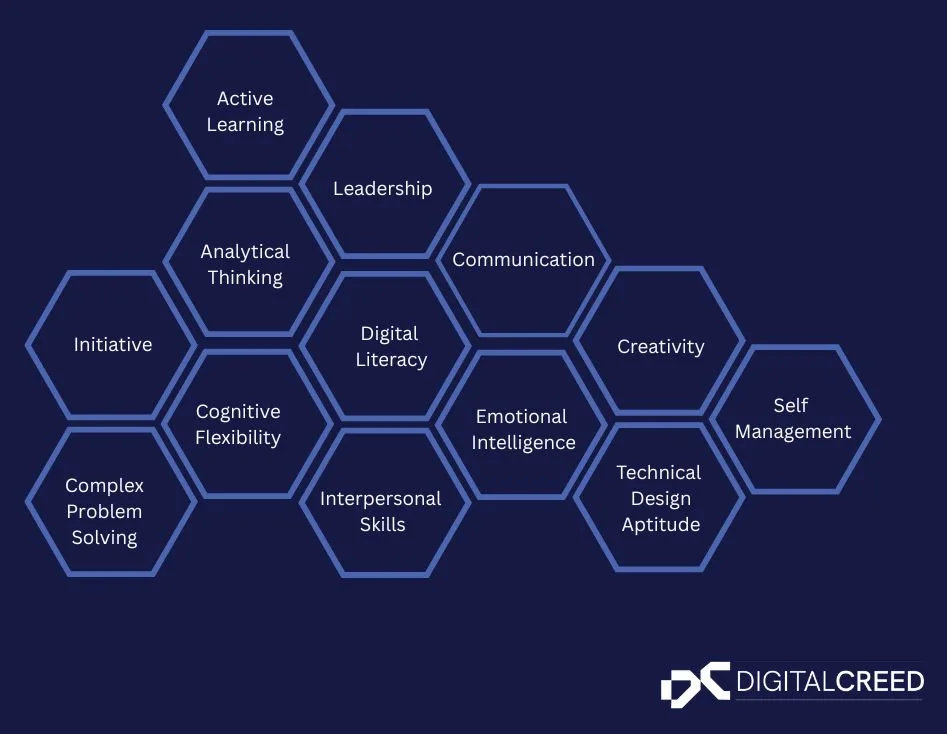
These are 13 skills that can improve your career opportunities in the future.
1. Active learning
Active learning is a procedure that utilises exercises to completely participate in the material you are attempting to learn. Being an active learner can assist you in developing relevant abilities and enable you to learn how to perform tasks effectively. You can develop dynamic learning abilities by engaging in conversations, performing in role-play scenarios and thinking critically to develop a comprehensive understanding of the material in hand.
2. Analytical thinking
Analytical thinking is the capacity to sort data into small groups to readily interpret information and make proper assessments. Many professions depend on this ability for research, critical thinking and to estimate trends. Insightful reasoning further develops dynamic abilities, which can make you a more dependable and compelling worker. One method for developing logical reasoning abilities is by being more attentive to environmental factors and putting effort into understanding the way in which systems around you work.
3. Complex problem-solving
Complex problem solving is the capability to accumulate data, scrutinise an issue and determine a solution. This skill enables you to address real-life professional scenarios effectively. Organisations deal with complex issues consistently and they recruit workers who can contribute effective solutions. For example, a nurse practises decisive reasoning each time they evaluate a patient. This can assist them in fostering a cycle for tackling a patient’s primary concerns.
4. Communication
It is highly essential to develop effective communication skills, both oratory and written, for any vocation. Effective communication skills can enhance your capability to interpret meaning from both spoken and written language and convey information in an eloquent way. In a workplace, communication is crucial to interact with professionals and attain business goals like increasing the sales figures of a product or service. Effectively communicating ideas to others, carefully listening during conversations, providing and receiving critical feedback and speaking publicly can enhance your career growth prospects within a company.
5. Cognitive flexibility
Cognitive flexibility is the capacity to multitask and adapt to various working environments. This skill requires strong observation and comprehension abilities. Developing this set of skills can enhance your success rate at work, and make you capable of adapting to new situations and achieving specific organisational goals. An employer may expect their employees to be cognitively advanced to meet the current market trends and industry requirements.
6. Digital literacy
Digital literacy has become immensely crucial across a variety of professional domains, as workflows evolve with technological advancements. Digital literacy refers to the understanding of the nuances of technology and its applications. Companies incline towards hiring employees who are technically competent. You can apply for higher roles in the company after taking up certification courses to develop competency in working with modern technology and tools.
7. Emotional intelligence
Emotional intelligence is a set of skills which enables you to control your emotions and comprehend the feelings of others. These skills are essential in a workplace as they enable you to understand your colleagues, resolve conflicts, minimise stress and enhance the quality of the work environment. This quality can help you collaborate with teams of professionals to achieve organisational objectives. You can create or further develop your capacity to appreciate people on an emotional level, by paying attention to and connecting with others, considering alternate points of view and assessing differences in opinion.
8. Leadership
Companies look forward to hiring employees with leadership skills, who possess qualities such as responsibility, initiative and integrity. These skills aid in collaboration, goal-setting and effective time-management. Having leadership skills is useful in any job role, and not just for administrative positions. You can utilise leadership abilities to be an effective team leader and to accomplish organisational objectives proficiently.
9. Interpersonal skills
Interpersonal skills are the essential capacities such as active listening, dependability, empathy, verbal and nonverbal communication and flexibility. These abilities can assist you in building strong professional connections, which can add to your career accomplishments. You can further develop your interpersonal abilities by being mindful of others and using relatable language when in conversation.
10. Initiative
Initiative involves the capacity to perceive where and how to make interventions to address a situation. Businesses might look for employees with the drive to facilitate organisational growth and development. Individuals who showcase a drive for excellence typically possess creative thinking capabilities and leadership skills, which are relevant for most work environments.Employers appreciate individuals who are self-sufficient and can work with little to no supervision. Taking initiative demonstrates significant administrative abilities, and positions you as a professional who can manage various projects and workflows on their own. Professionals with initiative may also find it easier to collaborate with people in a variety of departments.
11. Technical design aptitude
Technology is becoming more and more relevant in every industry, which is why it is useful to develop technical design skills. Technical design skills involve the ability to create, understand and improve digital user experiences. These skills are essential for mapping a customer’s journey, developing software, creating applications and websites and helping improve human interaction with technology. Developing a technical skill set can help improve your career opportunities and make you a more employable candidate.You can acquire technical skills by gaining expertise in performing physical or digital tasks. There are many different kinds of technical skills. Traditionally, people working in mathematics, computer science, mechanics and information technology have a range of technical skills. Today, many more industries rely on employees with technical knowledge.
12. Creativity
The act of turning new, innovative ideas into reality is known as creativity. Creativity includes the capacity to consider novel ideas and use your point of view to see circumstances in an alternate manner. Creative thinkers are significant contributors in a workplace, since they assist with developing imaginative content and frequently display advanced critical thinking abilities. Creativity is a very subjective and industry-specific skill, the particulars of which vary from domain to domain.Language, art, scientific theories and technological advancements are all outcomes of creative thinking. People who are creative continually ask questions and look for new perspectives. They may be more willing to try out new ideas at work, which can lead to establishing new practises in the workplace that are beneficial for everyone.
13. Self-management
Self-management is the capacity to be responsible for finishing a job and addressing time constraints in an effective manner. Self-management entails recognising your own responsibility in various elements of your job and taking the steps necessary to achieve an assigned task. Providing representatives with autonomy can significantly develop resourcefulness and the quality of their work. Hence, businesses may prefer hiring candidates who exhibit heightened self-administration abilities. You can develop this ability by using time productively and periodically defining objectives for yourself.
Republished by permission from Indeed. The orginal blog post appears here.