

Cybercriminals are Using AI to Outpace Financial Institutions: TrendAI

TrendAI research reveals nearly nine in ten organisations report a surge in AI-enabled attacks as cybercrime cartels industrialise operations.
TrendAI is a global leader in AI security, and empowers enterprises to innovate fearlessly by securing AI, cloud, networks, endpoints, and data across the modern attack surface.
Financial institutions are facing an unprecedented wave of AI-powered cyberattacks as cybercrime groups increasingly automate fraud, ransomware and intrusion campaigns, according to new research from TrendAI.
Photo by Jon Tyson on Unsplash
The Modern Bank Heists in 2026 report, based on a survey of 46 Chief Information Security Officers (CISOs) from financial institutions worldwide, reveals that attackers are no longer simply stealing data. Instead, they are actively disrupting defenders during live incidents, using artificial intelligence to increase the speed, scale and sophistication of attacks.
TrendAI surveyed 46 CISOs from financial institutions in June 2026 to better understand how AI, organised cybercrime and evolving attacker techniques are reshaping the threat landscape for the financial sector. Findings are published in the Modern Bank Heists in 2026 report.
Key findings
- 89% of organisations reported a year-on-year increase in AI-enabled attacks.
- 67% experienced “counter incident response”, where attackers actively interfered with security teams during live investigations.
- 41% suffered destructive cyberattacks over the past year.
- 55% reported an increase in API-based attacks.
- 46% experienced attempts to steal non-public market intelligence or investment strategies.
- More than half (54%) saw no increase in cybersecurity budgets despite the worsening threat landscape.
The report also highlights how cybercrime groups are rapidly adopting agentic AI to automate phishing, fraud and exploitation at machine speed. Rather than relying on individual operators, attackers are increasingly orchestrating specialised AI agents capable of running multiple stages of an attack simultaneously.
 Sharda Tickoo, Country Manager, India & SAARC, TrendAI: “The most concerning finding isn’t simply the rise in AI-enabled attacks. It’s that attackers are actively disrupting defenders while incidents are unfolding. When adversaries can interfere with your response as well as execute the attack itself, the traditional rules of cyber defence no longer apply. Organisations need autonomous security capabilities that can fight back just as quickly.”
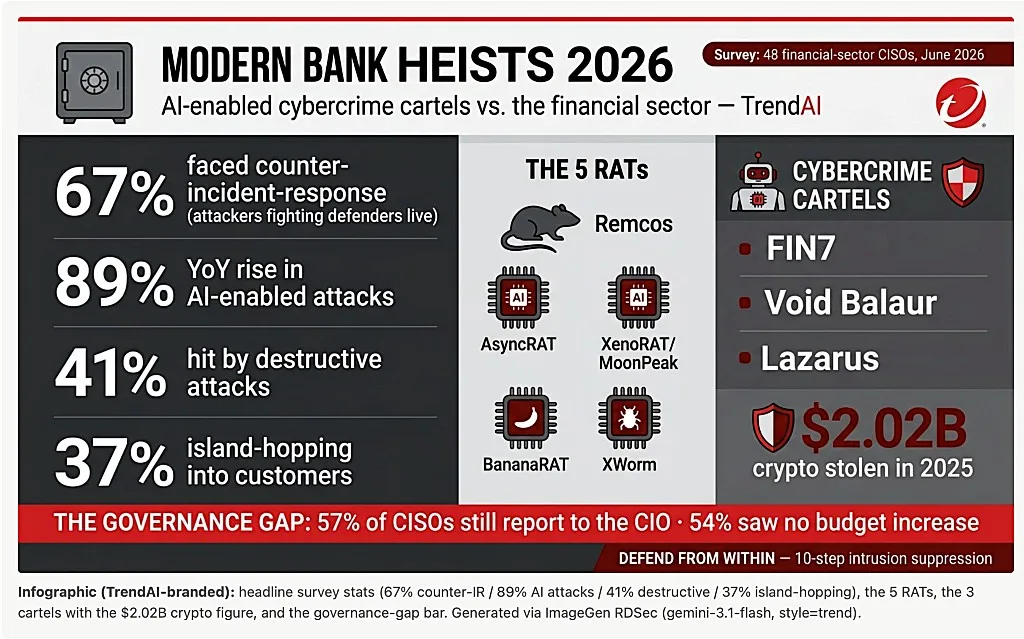
TrendAI researchers also identified growing use of advanced techniques including steganography, where malicious commands are hidden inside seemingly harmless images, allowing malware to evade traditional security controls. At the same time, commercially available Remote Access Trojans (RATs) continue to evolve, offering cybercriminals sophisticated capabilities once reserved for nation-state actors.
The report concludes that financial institutions must shift from reactive cybersecurity to proactive intrusion suppression by combining AI-powered detection, threat intelligence, virtual patching, managed detection and response, and executive-level security leadership.
Sharda added, “Trust has always been the foundation of banking. Today that trust is under sustained attack from cybercrime cartels using AI to scale operations faster than many organisations can defend themselves. Security leaders must be empowered to act independently, because defending financial institutions now requires continuous, intelligence-led operations rather than periodic response.”
Additional recommendations from TrendAI
To counter increasingly autonomous attacks, TrendAI recommends financial institutions:
- Adopt an intrusion suppression strategy that combines virtual patching, proactive threat hunting and managed detection and response.
- Build AI-enabled security operations capable of responding at machine speed.
- Strengthen protection against prompt injection, deepfake-enabled fraud and business email compromise.
- Elevate CISOs to independent executive leadership with direct responsibility for organisational cyber resilience.
