Every other day, the mainstream newspapers run an article about someone losing money to a fraudster. They were lured by a well-crafted message on social media or WhatsApp, offering to double their investment. Upon investing a small amount, their dashboard shows a profit that instils confidence and lures them to invest a larger amount. And this goes on, till the gross investment reaches a few lakh (or even crosses a crore). And when the happy investor tries to cash in, the system fails, and there is no response by phone or email from the scheme provider. One’s hard-earned investments are gone – poof! And then reality dawns. Too late! They just became a victim of Social Engineering.
As you just read, this is a con game that uses technology to enable communication and financial fraud. The conman invested time and resources in planning the con and in studying the victim’s background.
Ultimately, these crimes are about hacking the human mind – a tactic that has persisted for millennia.
But today, we have a fancy term for it: Social Engineering.
And we have technology that allows one to reach their victim without meeting them. That protects the identity of the conman, who can conveniently disappear without a trace, once the crime is committed.
In his book, Social Engineering, The Science of Human Hacking, Christopher Hadnagy provides a definition: Social Engineering is any act that influences a person to take an action that may or may not be in his or her best interests.
Well, it’s a rather broad definition, and the other aspect, writes Hadnagy, is that social engineering isn’t always negative.
We use it all the time to persuade someone to buy a product, service or idea. Just look at the wording in all those Instagram flyers – promising to make you rich in weeks. Or offering you an “out of this world” experience.
This involves some psychology, and I will write about that later in this article.
The point is that marketers have done much research to know what we want today. We want to look good, live healthier, get rich faster, get a job, get some recognition, go for an international holiday and post our holiday photos on social media.
Of course, the basis of all the above is survival. Let’s deal with the psychology behind this next.
Psychology
Abraham Maslow’s psychological theory has long been included in management course curriculum. The five-tier pyramid model titled, Maslow’s Hierarchy of Needs, is a familiar illustration in management and psychology textbooks.
Maslow’s Hierarchy of Needs is represented as a five-tier pyramid. It suggests that humans are motivated by basic, foundational needs.
The hierarchy is categorized into five distinct levels, starting from the base of the pyramid:
- Physiological Needs
- Safety Needs
- Love and Belonging Needs
- Esteem Needs
- Self-Actualization Needs
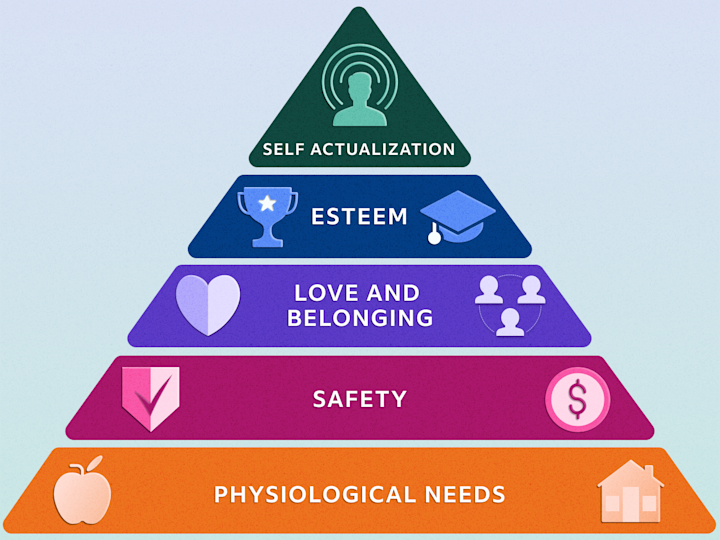
As we go through different phases of our lives, we prioritize our needs, moving up the pyramid – from physical and safety needs – until we finally achieve self-actualization, which is the pinnacle of the pyramid.
Self-Actualization represents the realization of a person’s full potential. It involves personal growth, peak experiences, and becoming everything, one is capable of becoming.
In the Stone Age, man’s needs were purely about survival and safety: food, water, companionship, and shelter from harsh weather. Discoveries were made to ensure this: fire, clothing, hunting tools, the wheel, communication methods, and using four-legged animals for transportation.
In a modern and highly competitive world, those basic needs are supplemented by materialistic things and societal status. So, we long for power, money, status, recognition, self-validation, instant gratification, and a long, healthy life.
But anyone who knows your needs and wants, can take advantage and con you. For instance, if you are in need of a job or a loan with low interest rates, and this information becomes knowledge to someone, they could approach you and swing the bait.
Fear and FOMO (fear of missing out) are other leverages for con men. The war in the Middle East resulted in a shortage of LPG cylinders and piped gas. Fraudsters took advantage and began circulating messages on WhatsApp and social media warning that “Your piped gas connection would be cut off – unless you paid the bill.” And a link was provided to pay the bill.
Did you pay your gas bill? Then why did you click the link out of curiosity (and take the bait)? That was a malicious link that connected with the banking apps on your phone. And perhaps, you lost a lot of money because of that careless click.
Did you not think? Impulsive actions can be very dangerous.
So how does a stranger get to know you without meeting you?
That’s where the enabler, that is technology, comes in.
Do not discuss your worries, fears and anxieties in WhatsApp groups or other online forums.
Profiling Victims
If you use any of the social media channels, then you are already giving out a lot of information about yourself. Posting messages on social media, asking for help. Sharing personal information on WhatsApp groups can also land you in trouble – if that information gets into the wrong hands.
An institution, such as a bank or a public service company, has your personal information for billing and KYC processes. That institution is bound by law to protect your information. It cannot share your details with other companies, without your explicit consent.
The Indian legal framework for this is emerging, with the DPDP Act of 2023 and the IT Act revisions. For decades, draconian laws did not protect consumers – so people took advantage of the lacunae in the laws.
Never post sensitive details like bank account or credit card numbers into public models like ChatGPT, Gemini, Claude, Meta Llama, Microsoft Copilot, Perplexity etc.
The Advice
- Stop posting personal details about yourself on social media.
- Do not discuss your worries, fears and anxieties in WhatsApp groups or other online forums.
- Never post sensitive details like bank account or credit card numbers into public models like ChatGPT, Gemini, Claude, Meta Llama, Microsoft Copilot, Perplexity etc.
- Always stay calm and be suspicious. Ask yourself questions like: Why am I getting such messages when I pay my bills on time? Or, why is a police officer calling me on WhatsApp to arrest me? Is that the acceptable procedure?
- Educate yourself and keep up. Follow the news and read about fraudulent incidents. Understand the modus operandi of the fraudsters.
- Educate others in your social circle.
Remember, panicking and acting impulsively will give the fraudster confidence – and you will be at a loss.
It could be a big loss – like your entire lifesavings.
And your health and peace of mind.