


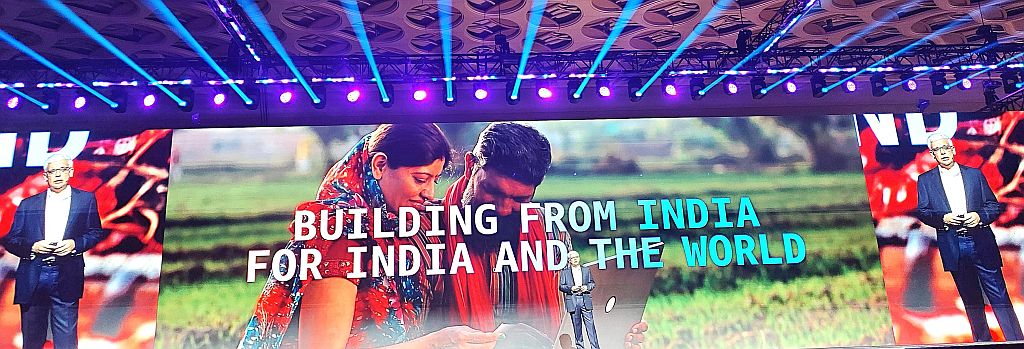
AWS Summit Mumbai: The Amazon Web Services (AWS) summit, now in its 20th year, is an event that software engineers mark on their calendars. It’s also an annual visit for me, as a media representative. Hoping to beat the crowds, I walk in at 8:30 AM – early by Mumbai convention time standards – through the glass doors of the sprawling Jio World Convention Centre, Mumbai. But I’m not early enough as I saw there were long queues for registration already. While AWS doesn’t release official numbers on attendees, a rough count would peg the footfall at 5,000 attendees (minimum). Maybe, closer to 8,000. The big number is an indicator of something significant – AWS is building something that matters to India and the world.
This summit is attended by a loyal tribe of software engineers, machine learning engineers, solution architects, cloud architects, DevOps leaders, data scientists, CIOs, CTOs, IT operations heads, startups, consultants, and those in the Amazon/AWS partner ecosystem. Together, this community builds a repertoire of applications, using 200+ full featured services running on the Amazon cloud platform.
‘Builder’ is a term AWS uses to profile software engineers, developers and cloud architects. I’m no builder, but being a former programmer gives me a sense of how much the DevOps workflow has evolved. Back in the day, it was one long piece of code (monolithic) and hours of debugging, using a compiler.
Today, software developers have much more respect, as they are building revolutionary solutions that make a huge impact. AWS is just one example, and you can see this in other cloud ecosystems as well.
In his opening remarks Sandeep Dutta, President, AWS India & South Asia highlighted examples of how AWS is empowering individuals and institutions for economic prosperity and social upliftment. Many of these solutions leverage frontier AI models running on the AWS cloud, powered by technologies such as Amazon Bedrock.
“In this past year, every builder I have spoken to across India has asked for one thing. Choice. The choice for the right AI model, for the right workload, running right here in India. That’s why we continue to expand model availability on Amazon Bedrock across AWS Regions, including bringing the latest models from Anthropic and OpenAI to the Mumbai Region in the future,” said Dutta.
Frontier models supported so far include OpenAI GPT-5, Anthropic Haiku 4.5 and Anthropic Claude Opus 4.7.
If it was gen AI in the last three years, today it is AI agents that are driving this transformation. AWS is providing builders the tools, platforms and services to innovate relentlessly.
Here are some examples of their innovation, made in India, for India, but can also be replicated in other countries.
Project Lakshmi (LXME)
India has more than 750 million women, 280 of whom are employed. Today, there are more opportunities for (India) women, who are increasingly educated, skilled and independent. As more women began to earn, there was a need for a platform to address their financial or wealth management needs.
Lakshmi (LXME) is a platform that caters exclusively to the financial and wealth management needs of Indian women, whether it is financial awareness, investments, or lending. Built on AWS, Lakshmi provides a hyper-personalized wealth management experience.
Dutta, who is highly optimistic about Project Lakshmi, is aiming to onboard 100 million beneficiaries on the platform, including 80 mn children under the age of six, with a corpus of INR 5 crore ($524,939). “That is not financial inclusion – it’s a new financial revolution,” he said.
India’s Space Program
In January 2025, India successfully achieved fully autonomous space docking of two satellites through the Space Docking Experiment (SpaDeX) mission. Conducted by the Indian Space Research Organisation (ISRO), this breakthrough made India the fourth country in the world to master the critical technology.
Space docking requires extreme precision and continuous communication between satellites and ground stations.
The Indian mission utilized two small satellites, SDX01 (Chaser) and SDX02 (Target), weighing roughly 220 kg each, which carefully reduce their relative velocity from orbital speeds of 28,800 km/h down to just 0.036 km/h before making contact.
Any miscalculation or (millisecond) communication latency can disrupt such missions and result in failure.
The communication support, regarded as the lifeline of the mission, was provided by Amazon ground stations. Amazon provided uninterrupted 20,000 antenna minutes (333+ hours) to this mission, contributing significantly to its success.
Dutta said Amazon is also going to contribute to mission Gaganyaan, India’s ambitious crewed mission to the moon, in 2027.
Kotak Mahindra Bank Scales for UPI
Increased mobile penetration and financial inclusion, thanks to the initiatives of Prime Minister Modi and his government, have led to a surge in mobile payments, enabled by India’s Unified Payment Interface (UPI). When UPI was introduced in April 2016, the system recorded just 373 transactions in the first month. According to latest figures reported by The Hindu Business Line, there are 23.20 billion UPI transactions every month, totalling ₹29.90 lakh crore in value. Each transaction is settled in less than a minute, anywhere in the country. It’s also adopted by other countries such as the UAE, Nepal, Bhutan and Singapore.
While that is a healthy sign for the economy and per capita growth, UPI is growing quickly and banks worry about scale. Core banking infrastructure must scale to support future growth of UPI transactions – or risk being slow and dissuading their customers. So, banks are modernizing their core banking systems.
For instance, Kotak Mahindra Bank, which logs more than one billion UPI transactions monthly, partnered with AWS to modernize its core banking and payment infrastructure. The bank utilizes AWS cloud capabilities to scale its digital services, build artificial intelligence agents, and enhance its overall cloud security architecture
Post this implementation, Kotak Mahindra Bank reduced its latency by one-fifth. “It’s no longer about coping up or catching up. It’s about staying ahead through innovation,” Dutta said.
Ministry of Women and Child Development
Traditionally, government grants to the poor and needy in India had to transcend through various layers before reaching the beneficiary. That led to multiple problems such as beneficiaries not receiving these grants or receiving a reduced amount due to processing fees deducted by the layers of institutions, not to mention corruption and theft of funds. To counter this, the Indian government set up a system of direct benefit transfer, after launching its Pradhan Mantri Jan-Dhan Yojana financial inclusion scheme.
Pradhan Mantri Jan Dhan Yojana is a financial inclusion program of the Government of India open to Indian citizens, that aims to expand affordable access to financial services such as bank accounts, remittances, credit, insurance and pensions.
Poshan Tracker, supporting the Ministry of Women and Child Development, has facially verified 75 million beneficiaries out of 89 million active users using Amazon Rekognition. In December 2025 alone, 27.9 million families received take-home rations through this system. These aren’t just statistics – these are real people whose lives are being transformed by technology.
“Now, every single rupee that the government spends reaches the right child, the right mother, and the right beneficiary,” said Dutta, who counts this as his favourite example.
India Investment
At the end of 2025, Amazon announced a $35 billion investment in India by 2030. The investment will create jobs, boost cumulative exports to $80 billion, and deliver AI benefits to 15 million small businesses. This is additional to the INR 40 billion already invested, which has helped digitize more than 12 million MSMEs and has generated INR 20 billion in exports. AWS has two regions, Mumbai and Hyderabad, that are gearing up to fuel the next level of growth in India.
“India’s ambition of becoming a $1 trillion economy by 2030 will happen only when AI is democratized and every citizen can use AI. Our digital public infrastructure will underpin this success,” said Dutta.
The writer was hosted by AWS India at the summit.