


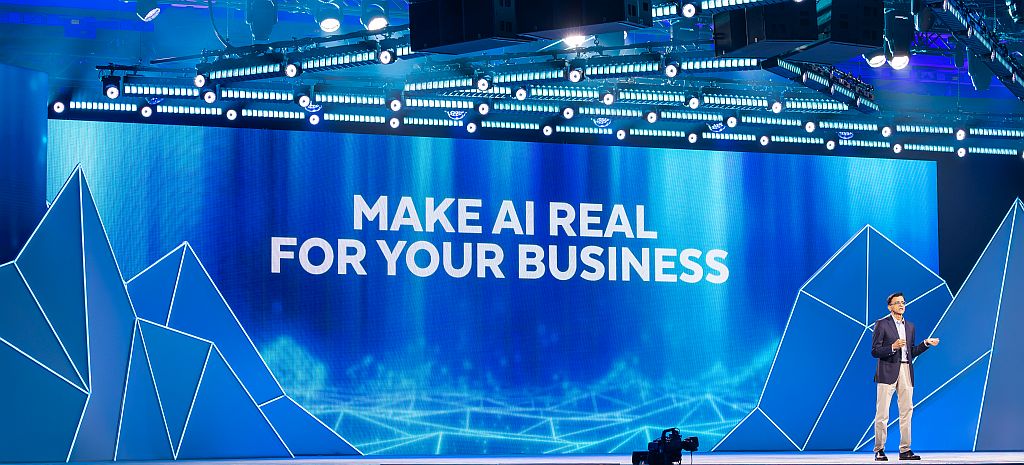
The phase of AI experimentation is behind us. In the age of Agentic Enterprise, organizations are moving more AI workloads from proof-of-concept to production. Aligning with this new phase, the core theme at Snowflake Summit 2026 (June 1 – 4) shifted definitively from “AI experimentation” to “Making AI Real for Business.” Snowflake is actively solving critical friction points that have historically slowed enterprises from moving AI agents and data pipelines from pilot to production. It is backing it with concrete product releases.
Collectively, the portfolio of Snowflake products reflects a platform approach toward intelligent, agent-driven experiences rather than standalone AI features. This could solve some of the biggest challenges that slow enterprises in taking their AI implementations from POCs to successful production.
While Snowflake’s engineering teams worked on these new products, they kept customer pain points in mind.
The Agentic Enterprise
AI models keep evolving and now there is an explosion of agents for various tasks. Yet, the data remains constant, though it grows. Models are shifting with a new version being introduced, with new capabilities, almost every week. That presents many challenges for enterprises, such as data governance, context, and making data ready for AI. Another key challenge is interoperability and access to data and business systems.
That calls for a complete rethink about how organizations think about the Agentic Enterprise.
“We like to think of the Agentic Enterprise as an organization where every single person in that organization is more productive, more efficient, and more leveraged because they can leverage AI. With the enterprise context, with access to the systems, with access to the data, and with the peace of mind of governance, compliance and security,” said Christian Kleinerman, EVP of Product, Snowflake.
With a plethora of AI models being adopted, Snowflake is helping its customers connect AI models to enterprise data, with enterprise context, and with security and governance.
“We give our customers access to these models, and we want to make sure that there’s connectivity and interoperability to other business systems, and to other data that may not be necessarily managed by Snowflake. SaaS and applications are very important too. All of this is coordinated by what we call agentic control plane, which is either Coco or CoWork, the technologies for builders and knowledge workers, respectively,” added Kleinerman.
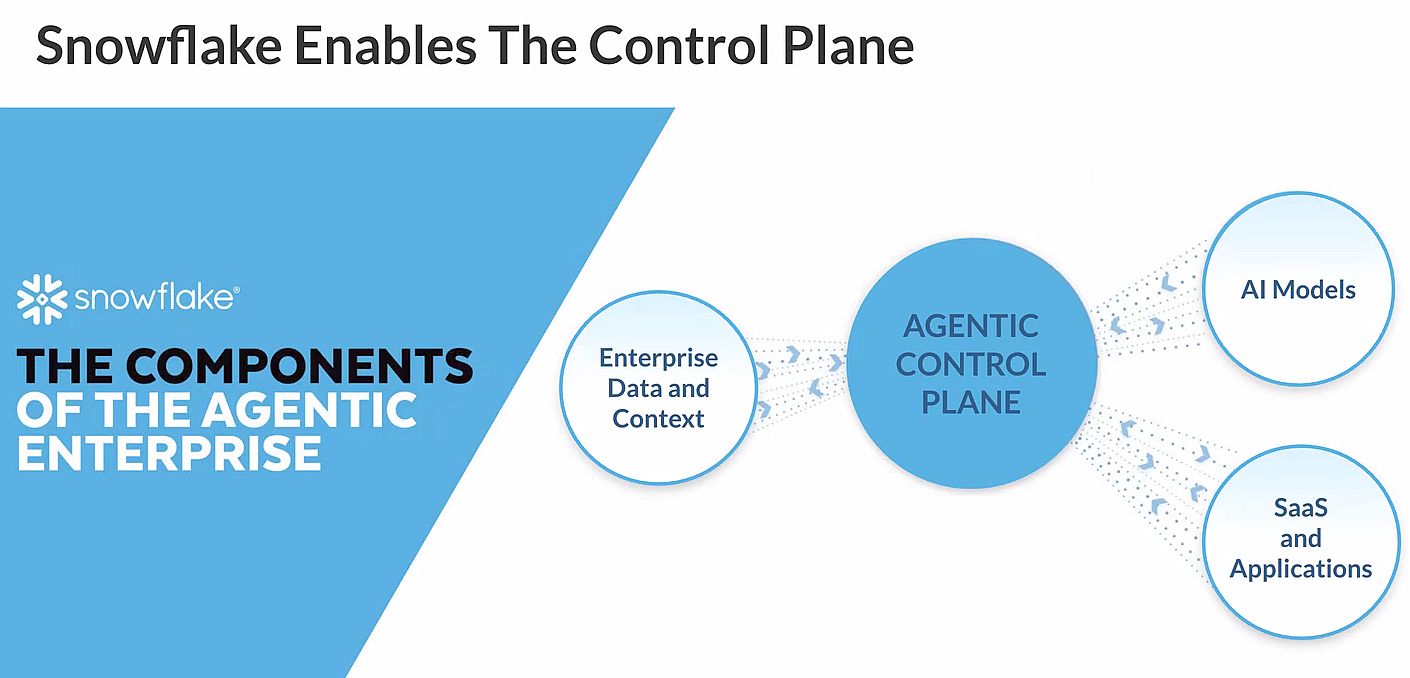
Image credit: Snowflake
Snowflake Innovations
Snowflake CoWork and Snowflake CoCo
These are the new names for Snowflake Intelligence and Snowflake Cortex Code respectively.
CoWork is a personal agent that helps knowledge workers to work smarter; it is for non-technical users. And CoCo is a coding agent for builders. Builders fondly referred to it as CoCo for a long time, so it was time to officially rename the product, informed Kleinerman.
Together, CoWork and CoCo represent Snowflake’s vision for the agentic enterprise, where AI systems can securely reason over trusted enterprise data and context, coordinate across business workflows, and help organizations move from insight to intelligent action with built-in governance and security.
Unlike generic AI assistants detached from enterprise systems, CoWork and CoCo are built directly on top of an organization’s governed enterprise data ecosystem already inside Snowflake. This allows organizations to securely orchestrate work, analytics, workflows, and software development with the governance, security, compliance, and interoperability enterprises require.
Even though the names have changed, the product vision and strategy remain unchanged.
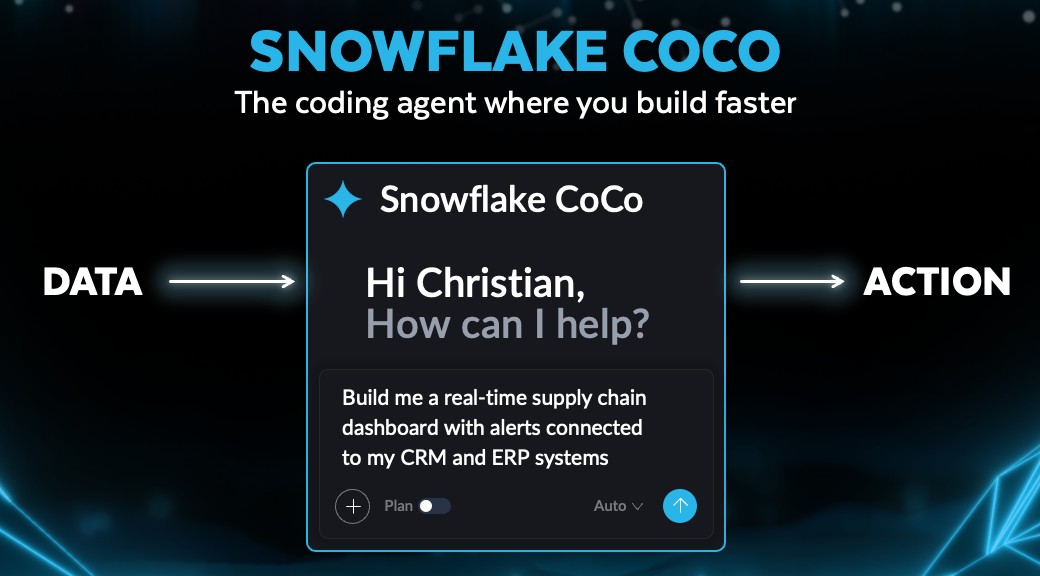
Image credit: Snowflake
Datastream
Snowflake Datastream is a fully managed, Apache Kafka-compatible data streaming service built natively into the Snowflake AI Data Cloud. It was designed to tackle a massive market problem: the steep engineering “tax” and security risks associated with managing separate streaming infrastructure alongside enterprise data lakes.
Unique features
- Consolidate Streaming and Analytics: Ingests data continuously into Snowflake native or Iceberg tables, blending data in motion and at rest on one platform.
- Governed by Horizon: Instantly secure streaming data upon arrival using existing Snowflake Horizon Catalog security and governance policies.
- Drop-In Kafka Compatibility: Connects your existing Kafka ecosystem with zero code changes, fully automated through CoCo setup.
CXO Impact
- Cut total cost of ownership and overhead by eliminating separate streaming systems.
- Secure data and AI centrally to drive confident, high-quality decisions.
- Launch production pipelines in minutes from scratch using CoCo.
Horizon Context
Announced at Snowflake Summit 2026, Snowflake Horizon Context is the active semantic and metadata enrichment layer built directly inside the Snowflake Horizon Catalog.
The Horizon Catalog is Snowflake’s unified catalog where data and AI are governed and managed. With a more complete and accurate set of data, the AI can produce better results or outcomes. However, understanding the business context has always been a challenge for AI models.
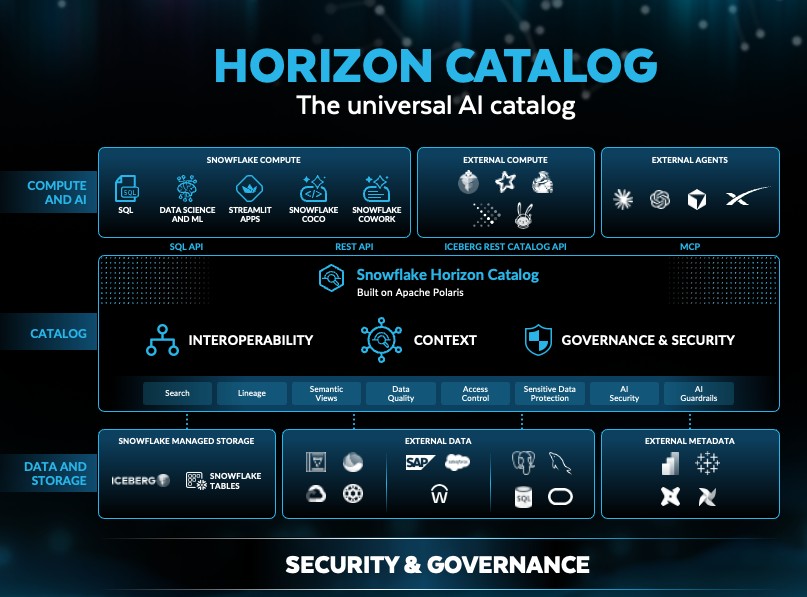
Image credit: Snowflake
The primary purpose of Horizon Context is to solve the “context problem” in enterprise AI and Business Intelligence. Kleinerman said Horizon Context represents a set of capabilities that will help organizations better manage semantics and metadata about their data.
It extracts semantic information from business intelligence tools, relational databases, ETL and data transformation systems used within the enterprise environment.
Here’s a typical scenario: When foundational AI models or business analysts look at raw tables without understanding corporate definitions (e.g., what exactly constitutes an “active customer”), they produce misaligned or hallucinated results. Horizon Context acts as a centralized “system of understanding,” capturing and maintaining business logic so every AI agent, app, and analytics tool operates from a single version of the truth.
Unique features
- Collect Context: Get context from disparate systems to give AI a complete picture of data inside and outside Snowflake.
- Enrich Context: Automate metadata enrichment and reduce manual effort to build and maintain a context layer while keeping humans in the loop.
- Activate Context: Easily discover, access, and automatically activate with CoCo.
CXO impact
- Full visibility across PostgreSQL, SQL Server, Tableau, Power BI, and dbt.
- Unified context through shared semantic definitions, query logs, schemas, and lineage.
- Trusted answers through CoCo using hybrid keyword and semantic search.
AI Security in Snowflake Trust Center
Trust Center offers proactive and built-in enterprise-grade security for data and AI. This time there is a focus on AI security and three new introductions.
First, the AI security package scans for common or potential risks, potential exposures – especially in the use of AI or in the use of agents. It will flag those potential issues or vulnerabilities.
Second, Snowflake is introducing a new set of data exfiltration policies. Customers will now have more control on what operations agents can run, at a granular level.
Third, Snowflake is introducing more capabilities around ransomware protection. The most notable feature is multi-party approvals (MPA), where for certain sensitive operations, it can be configured so that two administrators or two users need to take action to protect against, say, an agent taking unexpected actions, or an insider attack.
Multi-party approval (MPA) in the Snowflake Trust Center is a “four-eyes” authorization framework designed to mitigate insider threats and accidental destructive actions. It requires high-risk security operations to be explicitly approved by a second authorized administrator before execution.
Key use cases
Preventing Data Exfiltration: Protecting sensitive enterprise data from being exported or downloaded in bulk by rogue agents or compromised credentials.
Ransomware/Insider Protection: Blocking actions that attempt to disable security tools, tamper with immutable backups, or delete critical resources.
AI & Agentic Control: Guarding against unverified prompts or tool calls in AI workflows (such as Snowflake Cortex) that might inadvertently expose restricted data.
Source: Snowflake blog
Unique features
- Secure Guardrails: Uses AI signals and built-in defenses to block prompt-injection and secure agent actions.
- Centralized Governance: Manages your entire security posture and boundaries from a single control pane.
- Data and AI Protection: Triggers automated policies to block ransomware and prevent data exfiltration.
CXO impact
- Reliable enterprise-grade agent protection from day one.
- Fasttrack compliance and audit timelines from days to seconds.
- 24/7 global threat detection with proactive security across regions.
Adaptive Compute
This feature, which allows customers to automatically size their compute requirements, was introduced at the Snowflake Summit 2025. It adjusts performance as workflows evolve. According to Snowflake, Adaptive Compute will be available to all customers.
Unique features
- Operational Efficiency: Fully managed, workload-aware compute eliminates decision-making and manual optimization, lowering total cost of ownership, and reducing resource waste.
- High Performance: Performance dynamically adapts to evolving workloads, empowering teams to scale AI initiatives, faster without manual tuning.
CXO impact
- 6x faster analytics
- 2x more query/hour throughput
- 5x faster on DML operations
Interoperable architecture
Snowflake announced new capabilities that redefine interoperability for the AI era, enabling organizations to seamlessly access, govern, share, and act on data across systems without compromise.
For the first time, enterprises can work on a single, live, governed copy of their data wherever it resides across Snowflake, external lakes, and open systems, without moving or duplicating it. Powered by Snowflake Horizon Catalog, organizations can now transform siloed data into a connected, AI-ready foundation where users and AI agents securely discover, govern, and access their full business context.
Snowflake is advancing open interoperability with support for Apache Iceberg v3 and Snowflake Storage for Apache Iceberg Tables, enabling teams to seamlessly work across data inside and outside of Snowflake, while minimizing data movement. In addition, Horizon Catalog powered by Apache Polaris enables bi-directional read and write access using external engines to Iceberg data managed by Snowflake. Snowflake also extends consistent governance across open ecosystems with external engine access management and support for Iceberg REST Scan Plan API, ensuring fine grained protections apply across compatible engines. Together, these capabilities give organizations a unified, governed foundation for data and AI, unlocking interoperability without compromise.
The newly introduced Interoperable Lakehouse feature enables Snowflake customers to use any engine and accelerate AI on a single governed copy of their data.
“Most organizations still rely on moving and duplicating data just to make it usable, and that approach simply cannot keep up with the pace of AI. As innovation accelerates, data fragmentation becomes the constraint,” said Kleinerman, in a statement. “We are fully committed to interoperability and openness. With Snowflake’s capabilities, we are ushering in a new model for enterprise data, where customers can work directly on live, governed data wherever it resides through a single, connected governance plane. By eliminating duplication and defining shared business meaning through semantic views, we’re establishing a consistent, trusted foundation for both teams and AI agents.”
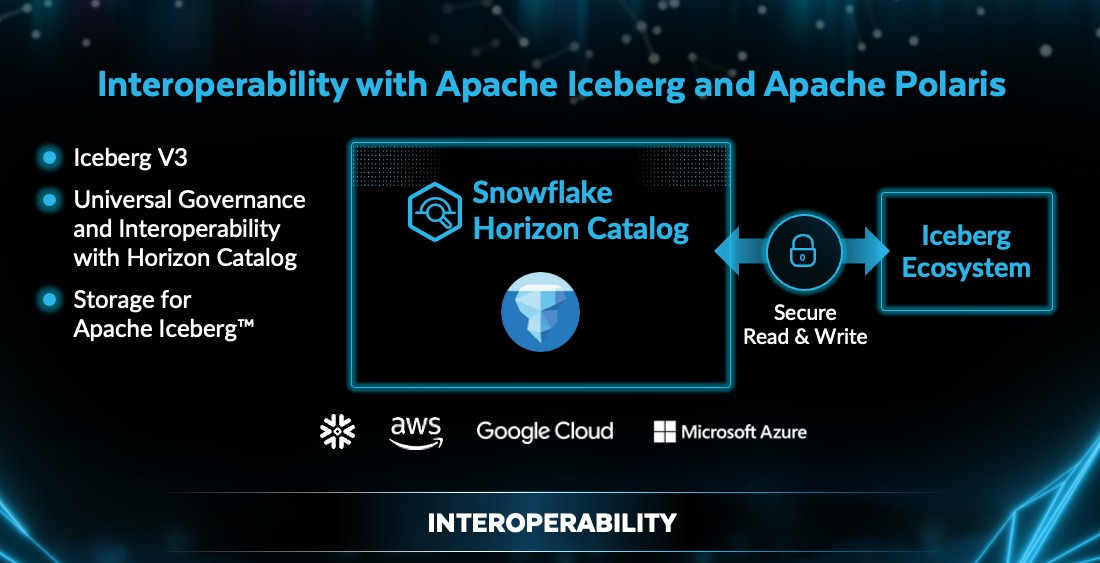
Snowflake advances interoperability without compromise across every layer of modern data architecture, enabling teams and AI agents to work from a single, governed, and logical data copy. Image credit: Snowflake
Unique features
- Access Data in Place: Securely read and write to any Iceberg table from any engine across more use cases.
- Interoperability Without Complexity: Native table experience and fully interoperable format, Apache Iceberg.
- Interoperable By Design: Snowflake enables data to work seamlessly across clouds, tools, and engines without vendor lock-in with general availability support for Apache Iceberg v3®, the broadest feature support on the market, and Snowflake Storage for Apache Iceberg Tables, delivering a complete interoperable platform for managing Apache Iceberg
- Universal Governance at Scale: Snowflake provides a centralized way to apply governance features consistently and securely across all data and platforms through Snowflake Horizon Catalog capabilities, powered by Apache® Polaris, for bi-directional Iceberg interoperability
- Powering Enterprises: Organizations including Affirm, Indeed, NTT DOCOMO, and Samsung Ads are using Snowflake to simplify their data architectures and build AI on a consistent, trusted foundation
CXO impact
- Avoid data movement and execute faster and lower costs.
- Increase AI fidelity with a single source of truth.
- Lower operating costs with an universal catalog for governance and access policies.
Snowflake CoWork
This is the personal assistant (agent) that enables worker productivity. Every employee will soon have their own personal work agent that answers complex questions, automates work, and takes actions, across tools.
“It enables every employee to have their own set of skills, their own set of MCP connectors, and most importantly, their own memory, and their own state that they can personalise,” said Kleinerman.
Snowflake believes the next generation of business intelligence is around the corner. In preparation for this, CoWork will include features such as the ability to schedule operations through automation and next generation dashboards.
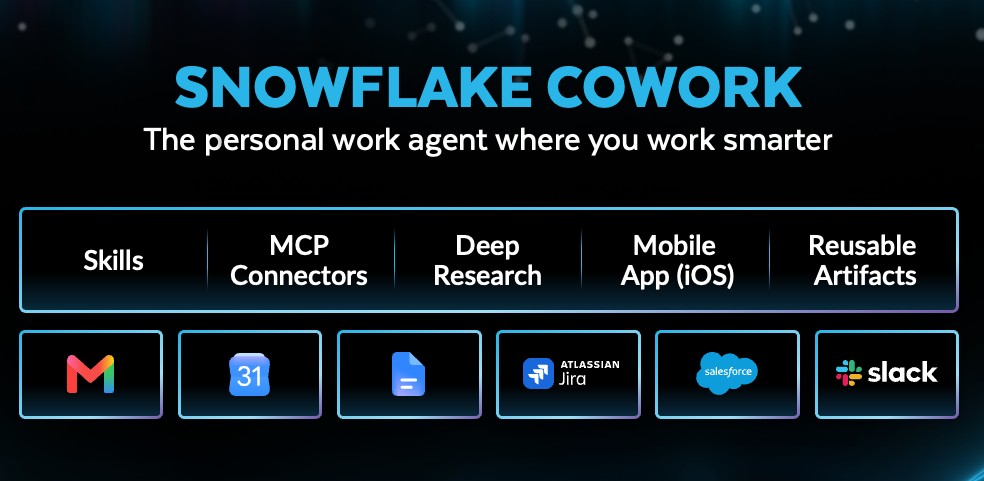
Image credit: Snowflake
Unique features
- Deep analysis, real action.
- Built-in skills for all personas in an enterprise.
- Agents reason through data to surface what matters, deliver briefs, and recommend actions.
CXO impact
- Understands your Snowflake data instantly: Cortex Sense auto-learns schemas, metrics, and business context from your data estate.
- Take action without switching tools: Draft emails, update tickets, post to Slack, and more from one governed conversation.
- Works proactively: Automations surface risks and insights before you ask.
Next Generation Dashboards
Dashboards will enable collaboration, commenting, sharing, and saving. For instance, if there is an analysis that a user runs periodically, they could use CoWork and save it as an Artifact and then recall it later or share it with coworkers.
“The introduction of next generation dashboards will position CoWork as an alternative for next generation business intelligence,” said Kleinerman.
Unique features
- Artifacts: Save and share live, governed analyses, charts, and conversations with RBAC-aware access.
- Certified Dashboards: Publish analyst-built dashboards from CoCo into CoWork for conversational exploration.
- Conversation Sharing: Share full threads with citations and context for collaborative decision-making.
CXO impact
- One-off answers become reusable team knowledge that compounds over time.
- Every viewer sees only the data they’re entitled to, live, not stale exports.
- Ask follow-up questions on any chart in natural language without switching tools.
Cortex Sense
This product turns metadata into AI context. Cortex Sense offers the ability to generate additional context, additional useful information from the not only the data that customers have in Snowflake, but from the usage of that data.
“[With Cortex Sense] we will know what data is required by data scientists. We will know what kind of data the data engineers use and how they use it. Cortex Sense will generate [contextual] information to enable coding agents and AI assistants to produce much better results without the need for configuration and metadata,” said Kleinerman.
Unique features
- Auto-builds context from your data estate, no manual setup.
- Global ontology & skills layer, shared across all agents.
- Pre-built plugins for finance, sales & more.
CXO impact
- Days, not weeks to production-grade agents.
- One context layer, works across CoCo, Cortex Agents & SI.
- 5x better than Claude Code + MCP.
New MCP Connectors
Newly introduced MCP connectors bridge the gap between Snowflake Cortex agents (CoCo and CoWork) and external business systems.
Snowflake just announced its intent to acquire a company called Natoma, which has an MCP gateway that provides connectivity to connectors with security.
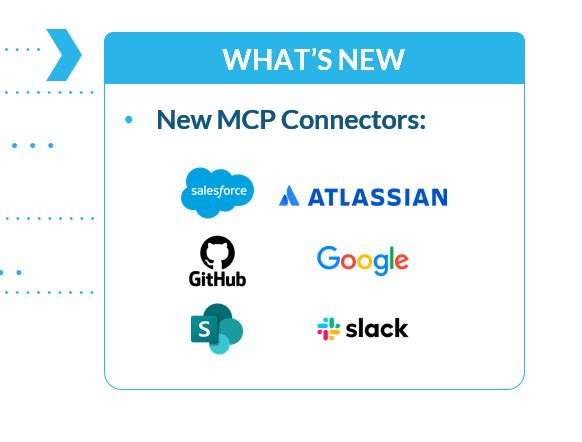
Image credit: Snowflake
Unique features
- Hosted MCP Server for any Snowflake Agent
- Hosted MCP Client with seamless integration
CXO impact
- Seamless integration across tools ensures uninterrupted productivity with zero midstream switching.
- Robust governance and access controls provide total peace of mind as data connects across systems.
- Full observability delivers complete audit compliance with traceable logs of every system action.
CoCo Desktop and More Surfaces
This introduction brings full agentic development on data in a native desktop IDE for Windows & MacOS.
“We are introducing a number of form factors for CoCo: an Excel plugin, a cloud code marketplace plugin, a slack integration. And of course, we will be announcing our desktop application soon,” said Kleinerman, speaking ahead of the summit.
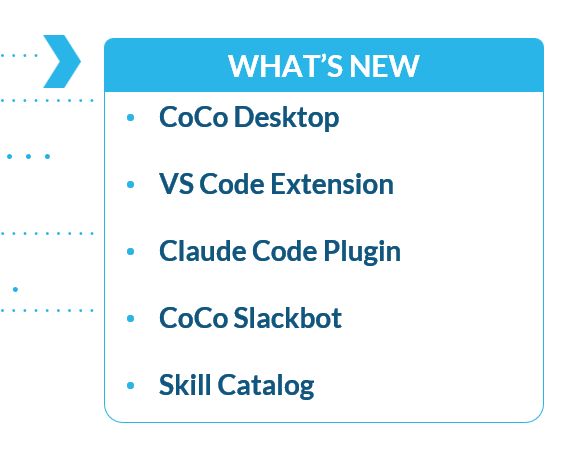
Image Credit: Snowflake
Unique features
- One governed surface to build across data stack.
- An always-on AI agent for your local machine.
- Scheduled tasks for repeatable workflows.
- MCP integrations and shareable skills/plugins.
CXO impact
- Ship production-ready pipelines, apps, and agents faster.
- Automate processes and tasks to increase productivity.
- Scale your best engineers’ expertise to every team.
Digital Creed was invited to attend the pre-conference briefing from India, and was briefed about all these innovations in advanced, with product demos, under embargo.
Tags: agentic, agentic AI, agentic enterprise, Snowflake, Snowflake Summit 2026, CoCo, CoWork, Snowflake Intelligence, Snowflake Cortex Code, control plane, Datastream, Apache Kafka, Apache Iceberg, Snowflake AI Data Cloud, Horizon Context, Snowflake Horizon Catalog, business intelligence, AI transformation, digital transformation, Snowflake Trust Center, Adaptive Compute, Interoperable Lakehouse, MCP, Cortex Sense, dashboards, artifacts, Snowflake agent, CoCo Desktop
Keyword phrases: agentic enterprise, Snowflake Summit 2026