


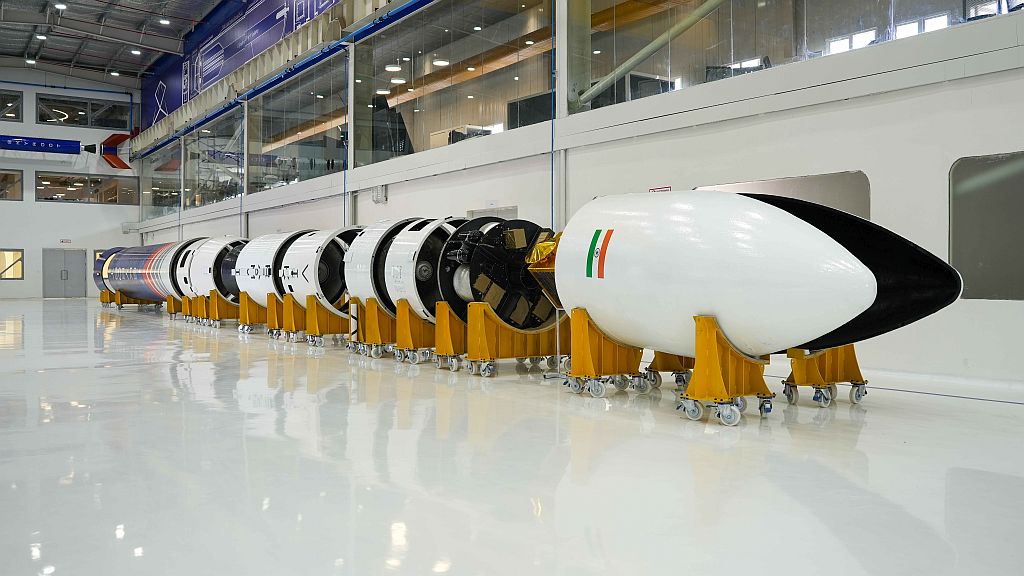
Skyroot Aerospace just became India’s first space tech unicorn after raising $60 million in its latest funding round, elevating its valuation to $1.1 billion. While the investment is a significant milestone for the company, it also marks the private sector’s entry into India’s ambitious space program.
Skyroot Aerospace has raised around US$160 million (as of May 2026) since its founding in 2018. It is backed by investors, including Singapore’s GIC and Temasek; Sherpalo Ventures; the founders of the Greenko Group; and Arkam Ventures.
Last October, Skyroot announced Vikram-1, its first orbital rocket, designed to launch satellites into orbit. Commercial launches are expected to begin next year.
The Hyderabad-based startup, founded by two former ISRO scientists, launched Vikram-S in November 2022, heralding the private sector’s entry into India’s space program. It plans to launch Vikram-2, a one-tonne-class vehicle with an advanced cryogenic rocket for the upper stage.
“Skyroot Aerospace becoming India’s first space-tech unicorn marks a defining moment for the country’s private space ecosystem. This milestone is far more than a financial achievement; it is the symbolic coming-of-age of India’s space startup landscape and a powerful validation of the technological ingenuity, entrepreneurial ambition, and commercial agility that Indian companies now bring to the global space sector. This achievement sends a strong signal to global investors that India has built a credible and innovation-driven space ecosystem capable of delivering world-class, cost-competitive, reliable, and on-demand space solutions. As the industry looks ahead to the Vikram-1 orbital launch, this achievement will further strengthen investor confidence and accelerate India’s collective mission of securing a 10% share of the global space economy by 2033,” said Lt. Gen. AK Bhatt (retd.), Director General, Indian Space Association (ISpA).
Public–Private Partnerships
Public–private partnerships emerged as a central operating model across the space value chain in 2025. Policy instruments including the New Space Policy 2023, liberalised FDI Policy 2024, and implementation of the Indian Telecommunications Act 2023 provided predictability for long-term private investment.
In Earth observation, IN-SPACe’s Build–Own–Operate framework began transitioning into implementation, signalling a shift in how satellite infrastructure and data services are developed and commercialised. Under the PPP push by IN-SPACe, the Pixxel consortium, led by Pixxel with partners Dhruva Space, PierSight, and SatSure, won a major Indian government contract of ₹1,200 crore to build and operate a 12-satellite network of India’s first commercial Earth Observation (EO) satellite constellation. The LVM3 public–private partnership model also advanced, with ISRO working closely with industry to scale heavy-lift launch vehicle production for commercial missions.
Expanding Startup Ecosystem and Industry Collaboration
India’s share of the global space economy, currently estimated at around 2 percent, is projected to increase to nearly 8 percent by 2033, driven primarily by private industry. Liberalised FDI norms and IN-SPACe’s single-window authorisation framework supported increased participation by both domestic and international players. India’s space ecosystem crossed an important scale milestone in 2025, with over 300 active space startups now operating across launch vehicles, satellite platforms, Earth observation, satellite communications, propulsion, electronics, space situational awareness and downstream analytics.
In 2025, industry-led collaborations across the ecosystem rose. Notable partnerships announced in 2025 included Kepler Aerospace with Astrome on satellite swarm communications, Pixxel integrating Dhruva Space’s Solis+ solar panels for its hyperspectral constellation, and Dhruva Space partnering with SatSure to deliver integrated Earth observation solutions. Additional collaborations included Bellatrix Aerospace with Skyroot Aerospace on propulsion systems, Ananth Technologies with Digantara on space situational awareness, and Azista working with Kepler Aerospace on satellite platforms.
Keywords: Skyroot Aerospace